
A unique archaeological discovery depicting the goddess Demeter, uncovered at the Gradište site near Mlado Nagoričane, provides further evidence of the existence of a ritual sanctuary in the ancient settlement dating to the 4th and 3rd centuries BC, archaeologist Dejan Gjorgjievski from the National Institution Museum Kumanovo announced following this year’s excavations.
“The ritual character of the area was confirmed by the discovery of a pithos whose rim bears decoration made with ring impressions, featuring the depiction of a female deity – Demeter(?), holding a cornucopia in one hand while performing a libation (liquid offering) with a kantharos onto a tripod with the other,” Gjorgjievski said.
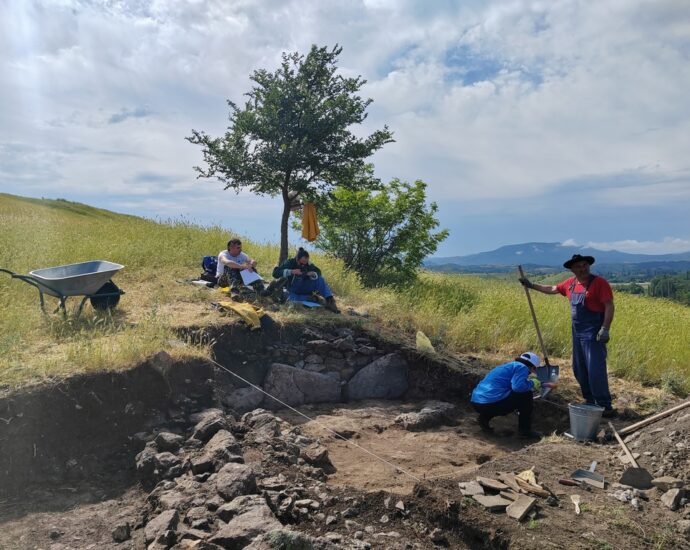
This year’s excavations focused on the “Lower Terrace” sector, where previous campaigns uncovered rock-cut structures, stone tumuli, votive vessels, ritual pits, and a water container, already indicating that religious ceremonies had taken place at the site.
In addition to the unique pithos, archaeologists uncovered the walls of a structure containing numerous fragments of pithoi and other storage vessels.
South of this area, they discovered an enclosing wall separating the ritual space from the rest of the settlement.
Adjacent to it, archaeologists also uncovered a smaller room which they believe was most likely used for symposia or ritual meals.
Inside, they found large quantities of animal bones, mainly from wild boars and goats, together with a rich assemblage of tableware dating to the 4th and 3rd centuries BC.
The discoveries also include numerous imported ceramic objects, including West Slope kantharoi and gutti, black-glazed pottery, amphorae, hydriae, lamps, and ceramic figurines.
Particularly significant are the remains of an elaborately decorated couch, including a profiled leg and an applique depicting a deity holding a ritual vessel while reclining on a kline.
“We believe this room was also connected with the rituals performed within the temenos—possibly for ritual meals, similar to the Sanctuary of Demeter and Persephone in Corinth,” Gjorgjievski said.
According to him, the large quantity of imported pottery and the remains of luxurious furniture, which have only a few known parallels outside the rich tombs of Pella and the royal tombs at Aigai (Vergina), once again confirm the high level of development of the settlement, its extensive trade, and its full integration into the civilization of the Kingdom of Macedon during the 4th and 3rd centuries BC.
“Future excavations will focus on further investigating the structures uncovered this year and the possible existence of a temple in this part of the site,” the archaeologist added.
The excavations were carried out as part of the Annual Programme of the National Institution Museum Kumanovo, with financial support from the Ministry of Culture and Tourism.