
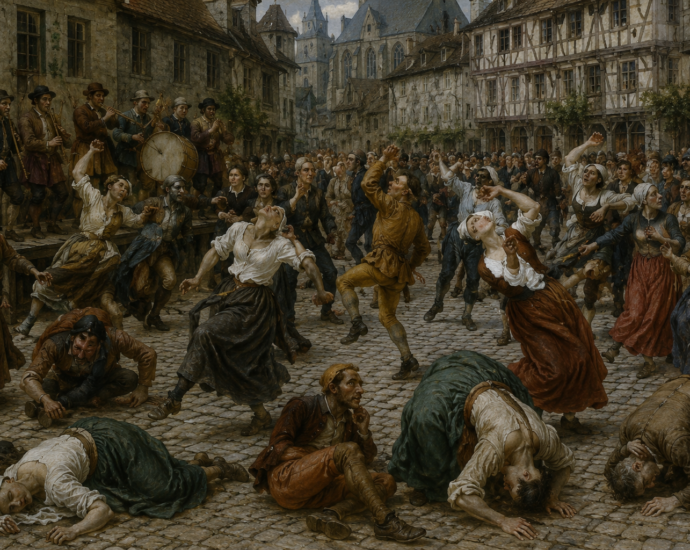
Imagine waking up one morning and seeing your neighbors dancing in the streets. Not at a festival. Not at a celebration. But dancing uncontrollably for days, unable to stop even as their bodies collapsed from exhaustion.
This is exactly what historical records describe during the infamous Dancing Plague of 1518, one of the most mysterious events ever documented in European history. The outbreak took place in Strasbourg, then part of the Holy Roman Empire and now located in France. Contemporary accounts report that a woman known as Frau Troffea suddenly began dancing in the street in July 1518. Within days, dozens joined her. Within weeks, the number reportedly grew to around 400 people.
Witnesses claimed many participants danced for days or even weeks with little rest. Historical reports suggest some collapsed from exhaustion, dehydration, strokes, or heart-related complications caused by extreme physical exertion.
What makes the story even stranger is the reaction of local authorities. Believing that the victims suffered from a condition caused by “hot blood,” officials hired musicians and even built stages so the afflicted could continue dancing. Instead of helping, the number of cases increased.
For centuries, historians and scientists have debated what caused the phenomenon.
One of the earliest scientific theories suggested poisoning by ergot, a fungus that can infect rye. Ergot contains compounds capable of causing hallucinations, spasms, convulsions, and altered mental states. Because rye was a common food source in the region, some researchers believed contaminated grain may have triggered the outbreak.
However, modern researchers have raised serious objections to the ergot theory. People suffering from severe ergot poisoning typically experience symptoms such as intense pain, gangrene, and loss of blood circulation in the limbs, making prolonged dancing physically unlikely. Furthermore, similar dancing outbreaks occurred in places where ergot contamination was less likely.
Today, many historians favor a different explanation: mass psychogenic illness, sometimes called mass hysteria. According to this theory, the people of Strasbourg were living through a period of famine, disease, economic hardship, religious anxiety, and social stress. In such extreme conditions, psychological distress may have manifested physically and spread through the population.
Medical historian John Waller argues that widespread belief in supernatural punishment, especially the fear of being cursed by Saint Vitus, may have made people particularly vulnerable to entering trance-like states that spread through suggestion and collective belief.
More than 500 years later, no single explanation has been universally accepted. The Dancing Plague of 1518 remains one of history’s most fascinating mysteries, sitting at the crossroads of medicine, psychology, religion, and human behavior.